The Secret of Black Holes

Finnegan Flynn
| 27-10-2026
 · Astronomy Team
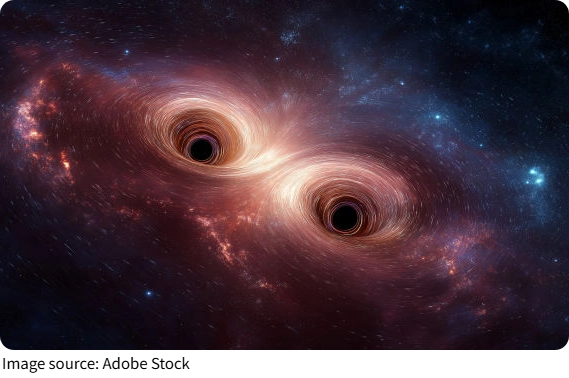
Black holes are among the most mysterious objects in the universe. Although their gravitational pull is so powerful that even light cannot escape from within their event horizons, the material surrounding them can produce spectacular eruptions.
Astronomers have now discovered that black holes of vastly different sizes may follow the same fundamental rule when launching powerful jets into space.
The findings, published in Nature Astronomy in October 2026, could help scientists understand these dramatic events and predict when certain black holes are most likely to become active.
Why Black Holes Produce Powerful Jets
Black holes grow by attracting surrounding material, including gas, dust and sometimes the remains of nearby stars. However, this material does not necessarily disappear immediately.
As matter spirals towards a black hole, some of it can be redirected into enormous jets that travel far into space.
These outflows carry substantial amounts of energy and may influence conditions within surrounding galaxies.
One longstanding mystery is why some black holes produce jets almost immediately after consuming stellar material, while others remain relatively quiet for months or years.
Researchers now believe that the answer may depend on how quickly a black hole is consuming matter.
A Universal Rule Across The Universe
The research was led by astrophysicist Adelle Goodwin from Curtin University in Australia, working with Andrew Mummery from the Institute for Advanced Study in Princeton.
Their findings suggest that black holes can activate delayed jets when their feeding rate falls to approximately 2% of a theoretical benchmark known as the Eddington limit.
This limit describes the balance between the outward pressure generated by radiation and the inward gravitational attraction of an astronomical object.
Remarkably, the same critical threshold has previously been associated with jet formation in much smaller black holes.
Some black holes are only around ten times the mass of the Sun, while supermassive examples can be millions of times heavier.
Despite these enormous differences, the underlying mechanism appears surprisingly consistent.
How Scientists Made The Discovery
The researchers examined events known as tidal disruptions, which occur when a star passes dangerously close to a supermassive black hole.
Powerful gravitational forces tear the star apart, allowing some of its material to fall towards the black hole.
These events provide astronomers with an unusual opportunity to observe changes in feeding behaviour over relatively short periods.
The team initially examined 20 tidal disruption events using observations from radio telescopes and instruments measuring visible, ultraviolet and X-ray radiation.
They then selected ten events with sufficiently detailed information to compare feeding rates and the timing of radio outflows.
The analysis revealed a consistent relationship between declining feeding activity and delayed jet formation.
Why Some Eruptions Happen Years Later
The study identified two possible stages of jet activity.
The first occurs when a black hole is consuming material at an exceptionally high rate.
The second can happen hundreds or thousands of days later, when its feeding rate drops towards the critical threshold.
This could explain why some black holes appear inactive long after tearing apart a star before suddenly producing detectable radio emissions.
Rather than being entirely unpredictable, these delayed eruptions may follow a shared physical pattern.
What The Discovery Means For Astronomy
Predicting when black holes produce jets could improve how scientists use powerful radio telescopes. Observing time at major astronomical facilities is limited, making it important to identify the most promising targets.
If researchers can estimate when a black hole will approach the critical feeding rate, they may be able to schedule observations around the expected eruption.
This could be particularly valuable for the Square Kilometre Array Observatory, a major international radio astronomy project with infrastructure in Australia and South Africa.

A New Understanding Of Cosmic Giants
Although further observations are needed to establish how widely the rule applies, the findings strengthen the idea that black holes operate according to similar physical principles regardless of their size.
The research also demonstrates how studying rare astronomical events can reveal connections that would otherwise remain hidden.
By uncovering a possible common trigger for delayed jets, astronomers have taken another step towards understanding some of the universe's most powerful phenomena.

